6 Leak Spots to Check Before Friday's Las Vegas Rain
Picture Saturday morning. The rain was light, the street is already dry, and a tea colored ring has shown up on the ceiling under the patio roof. The National Weather Service gives the valley a 50 percent chance of rain Friday night, November 13, and the same odds again Monday night. Six spots on a Las Vegas house decide whether that water stays outside. You can check most of them from the ground before the first drop.
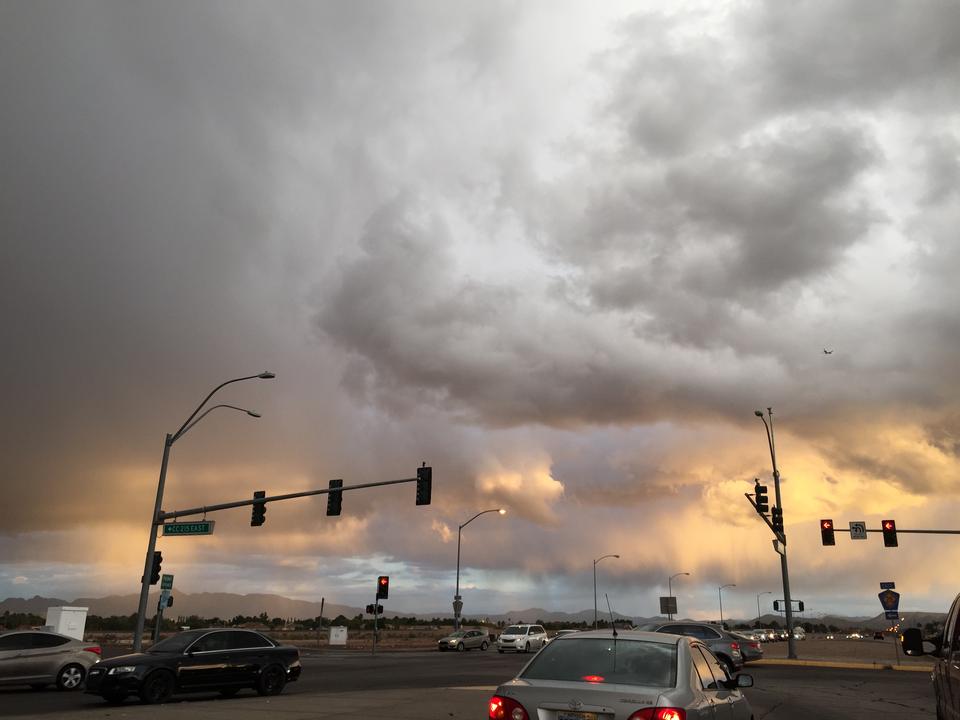
- The forecast issued Wednesday, November 11 calls for light rain Friday night into Saturday, then another system Monday into Tuesday. No flood watch was posted that day.
- The airport has logged 1.75 inches since September 28. That is 44 percent of a normal year, and the third wettest such stretch in 90 years of records.
- Half of the last 10 Novembers had no measurable rain at all. Last November had 1.64 inches.
- In a lab test, a roof scupper that was 75 percent blocked backed water up past 17 inches. The same scupper ran 5 inches deep when clear.
- A flood policy bought today starts in 30 days, FloodSmart says. It will not cover this weekend.
What the Forecast Says for Friday Night
I am writing this on Wednesday, with clear skies and a high near 77 F. The National Weather Service point forecast for the valley shows a 50 percent chance of rain Friday night, mostly between 10 p.m. and 4 a.m., with showers and a possible thunderstorm after that. Saturday morning carries about a 30 percent chance before the sky clears.
The forecast discussion from the Las Vegas office explains why. A stronger wave swings through Friday night into Saturday. The Sierra will wring out much of its moisture, yet the office wrote that confidence is increasing in at least some light rain at desert elevations. It also said the storm track stays active, with the next chance of widespread rain and gusty wind Monday into Tuesday and more systems possible later in the week.
So this is not a flash flood setup as of Wednesday. No watch or warning was active for the valley when I looked. It is a light, steady rain setup, and that kind of rain is a free leak test. Nothing gets overwhelmed in a light rain, so any water that shows up inside points at a real defect.
Forecasts move. The Dry Vegas storm tracker shows the live weather service forecast and any alert over your neighborhood.
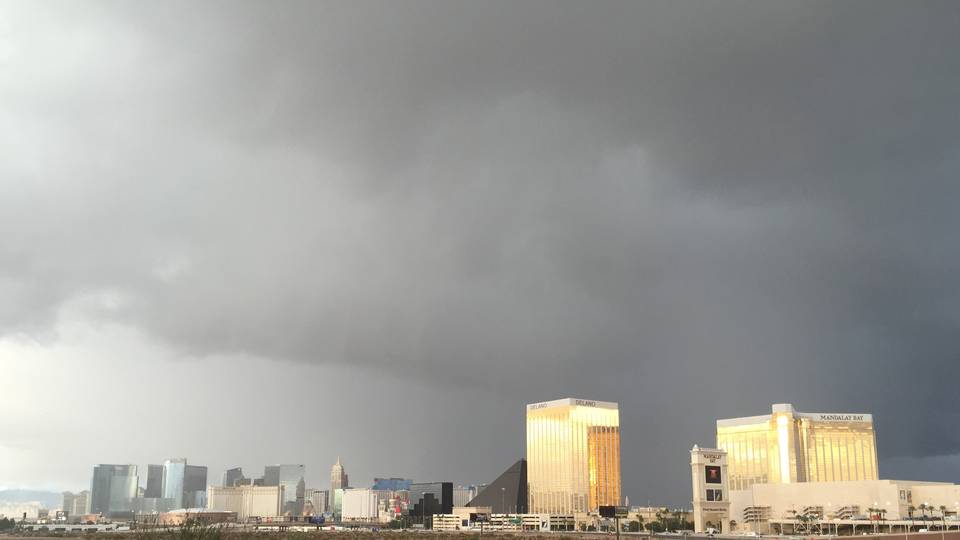
This Fall Is Already the Third Wettest in 90 Years
I went through the daily rain record for the Las Vegas airport series, which runs from 1937 through November 10, 2026. The counts in this section are ours. The National Weather Service NOWData tool serves the same record if you want to check them.
Seven days since September 28 brought measurable rain, and together they add up to 1.75 inches. NOAA's 1991 to 2020 normal for a whole year is 3.99 inches, so the valley took in 44 percent of a normal year in about six weeks. Only 1960 and 1987 had more rain between September 28 and November 10, with 2.37 and 2.29 inches.
Every Rain Day at the Las Vegas Airport Since September 28, 2026
October alone came to 1.31 inches, the second wettest October in the record behind 2005. Most of it fell on October 11. That matters for your house. Every weak spot on the roof and around the windows has already been tested once this fall, and the stain it left is your map.
What November Usually Does
November is a coin flip here. NOAA's normal for the month is 0.29 inches. In the record, 26 of 89 Novembers had no measurable rain, and that includes five of the last 10. Then a wet one arrives. November 2019 had 1.06 inches, and November 2025 had 1.64 inches, the fifth wettest November in the record.
November Rain at the Las Vegas Airport, Last 10 Years
Big single days are rare but real. Only 23 November days in the whole record brought a half inch or more. The wettest was November 22, 1965, at 1.09 inches. The longer story is in our Las Vegas storm history.
6 Leak Spots to Check Before the Rain
National rain checklists start with the sump pump and the basement window wells. A valley house on a slab leaks in different places. I would walk these six in this order, and the whole lap takes less than an hour.
- Scuppers and flat roof drains. A scupper is the opening that lets water off a flat roof or patio cover through the low wall at its edge. Leaves, palm litter and dust pile up in front of it over a dry year. Engineer Jim Koontz tested this in a steel tank, in a study published by the roof consultants institute IIBEC. A clear 6 by 6 inch scupper ran 5 inches deep at 100 gallons a minute. With 75 percent of the opening blocked, the water rose past 17 inches. Clear the debris by hand from a ladder at the roof edge, and look for a brown streak on the stucco below, which shows where water has overflowed before.
- Tile roof valleys and cracked tiles. The tile is not the waterproof layer. The Journal of Light Construction field guide says the underlayment and flashings provide the actual waterproofing on a clay or concrete tile roof. Stand in the yard with binoculars. Look for cracked or slipped tiles and for debris packed into the valleys where two slopes meet. I would stay off the tile and leave the repair to a roofer.
- Window weep holes and slider tracks. These are the small slots at the bottom of a window or patio door frame. The Department of Energy's Building America guide says they drain water out of the frame, and that a clogged one can damage the framing, sheathing and insulation in the wall. Its test takes one glass of water. Pour it into the track and watch for it to come out of the slot outside. If nothing comes out, clear the slot with a pipe cleaner, and scrape away any caulk or paint that covers it.
- The weep screed at the bottom of the stucco. This is the metal strip with holes where the stucco ends near the ground. It lets water that got behind the stucco drain back out. The International Residential Code, as a Maricopa County building directive quotes it, puts that strip at least 4 inches above earth and 2 inches above paving, and says the holes shall never be covered. Walk the wall. Pull back rock, soil or mulch that has climbed over the strip, and note any patio slab poured up against it.
- The slope of the ground at the wall. EPA's mold guide says to make sure the ground slopes away from the foundation. The Building America guide gives the number, a half inch of fall per foot for 10 feet, and a 2 percent slope on patios and driveways. Where a side yard is too narrow for that, the same guide calls for a swale or a drain. Run a garden hose on the patio for five minutes and watch where the water goes. Then clear any yard drain grate you find.
- The door where runoff came in last time. If water crossed a threshold or a garage floor in October, expect the same path. Clark County says empty sandbags and sand piles are available at the City of Las Vegas service centers, at 2900 Ronemus Drive near Cheyenne and Buffalo and at North Mojave Road and Bonanza Road. Bring a shovel and a way to haul them, because you fill and carry your own.
Gutters belong on the list if your house has them. The City of Las Vegas says to clear gutters and drains before stormy weather, and Ready.gov says the same.
The Ten Minute Walk After the Rain
Saturday morning, before the house dries out and hides the evidence, walk it again from the inside.
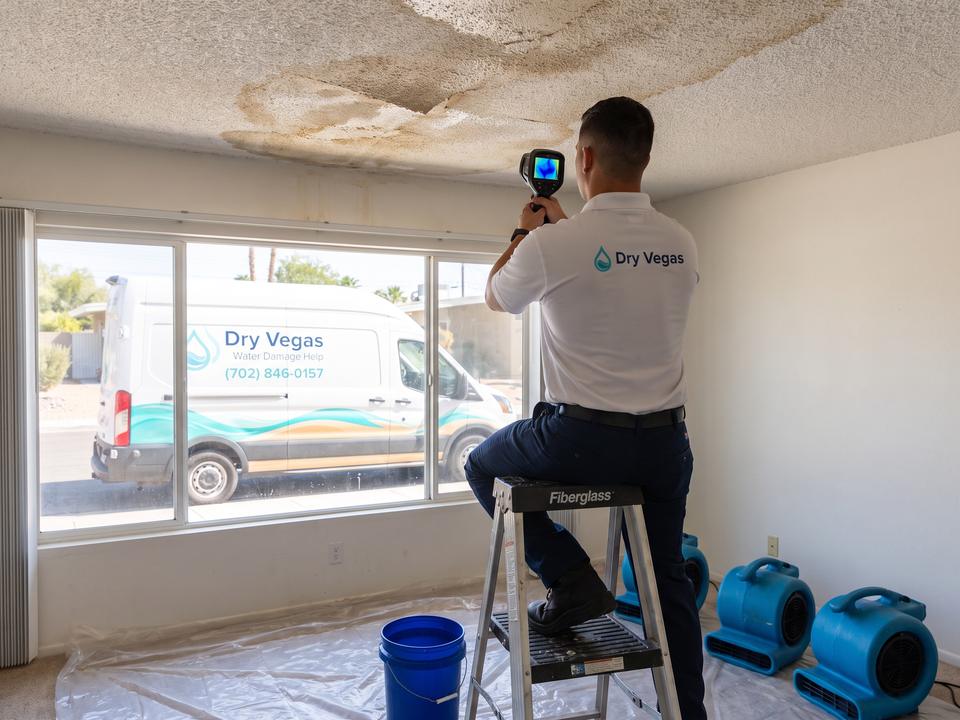
- Look up first. Check ceilings under flat roof sections, under roof valleys and around skylights and vents. A new ring or a soft spot marks the leak.
- Run a hand along the window sills. Damp drywall under a window points at the weep holes or the flashing.
- Check the baseboards on outside walls. Swelling or a dark line near the floor means water came in low, at the screed or under a door.
- Look at the flat roof on Monday. The home inspector group ASHI defines a ponding roof as one that still holds water 48 hours after a rain. Standing water that long means a drain or the slope needs work.
- Photograph everything you find, with the date, before you move or wipe anything.
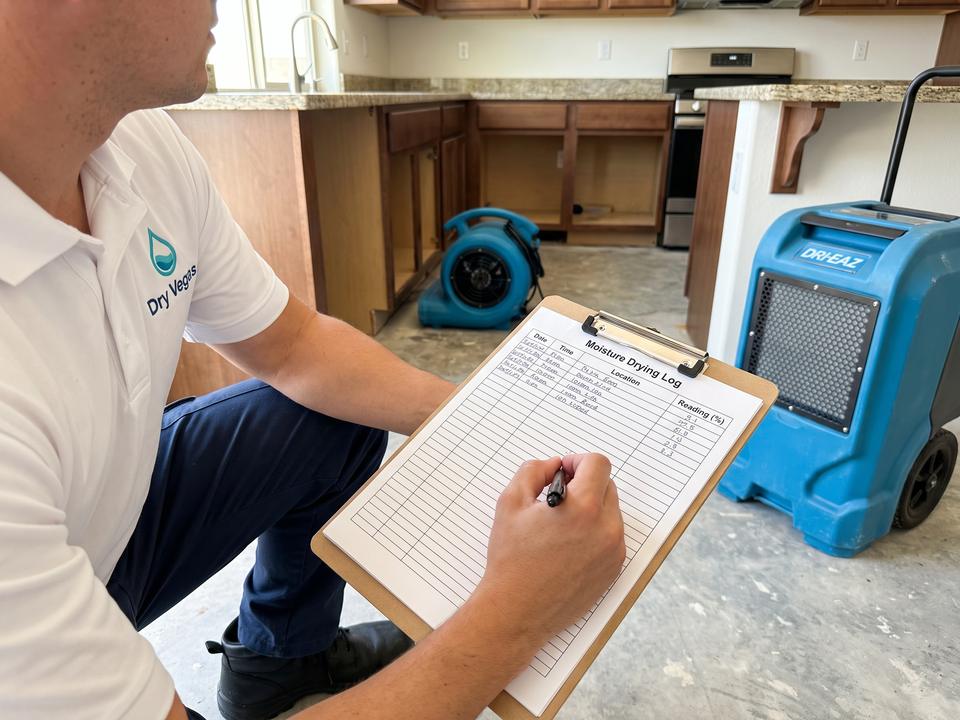
If something is wet, the clock has started. The EPA says to dry water damaged areas and items within 24 to 48 hours to prevent mold growth. A small stain can sit under a wider wet patch of insulation, so a moisture reading beats a guess. Our ceiling and roof leak page covers that work, and structural drying shows how readings decide what stays.
A wet floor with no stain above it is a different puzzle. Our post on telling storm water from a slab leak walks through the water meter test.
What Insurance Does With Rain Damage
Three lines from the Insurance Information Institute cover most of it. Windstorm and hail are covered perils on every standard home policy form. Flood damage is excluded under standard homeowners and renters policies. And a policy will not cover damage due to lack of maintenance.
So the entry point decides the claim. Rain that came through a hole the wind just made is one conversation. Rain that came through a roof drain nobody cleared is another. Water that rose from the street and crossed the threshold is flood, and that takes a separate policy. Your own wording controls, so read it before you call.
Flood coverage cannot be bought for this storm. FloodSmart, the federal flood insurance site, says a new policy goes into effect 30 days after purchase, with few exceptions. It lists limits of $250,000 for a home's building and $100,000 for contents. A policy bought this week would start in the middle of December, which is still ahead of the wetter winter months.
Before the rain, take a photo of each ceiling and each outside wall. A dated before picture is the cheapest claim document you will ever make. More is on our insurance claim help page.
Old Advice That Stuck
It does not rain here in November. Some years that holds. Five of the last 10 Novembers had no measurable rain at the airport. The other five did, and last November's 1.64 inches was more than five times the normal for the month.
A light rain cannot hurt a house. A cloudburst overwhelms good drains, and nobody blames the roof. A light rain that still leaves a stain is telling you something failed. Treat the small stain as the cheap warning.
Start with the sump pump. Ready.gov's flood page suggests a sump pump with a battery and check valves. That is sound advice for a house with a basement. If your house sits on a slab, spend the same hour on the roof drains and the ground at the wall.
Caulk every gap you can find. Some gaps are drains. The Building America guide warns that weep holes get clogged when they are caulked by accident, and the residential code says the holes in a weep screed shall never be covered. Seal cracks. Leave the drains open.
Loose Ends
How much rain does Las Vegas get in November?
NOAA's 1991 to 2020 normal is 0.29 inches for the month. The real answer swings between nothing and a lot. By our count of the airport record, 26 of 89 Novembers had no measurable rain, and the wettest, in 1965, had 2.22 inches.
Where can I get sandbags in Las Vegas?
Clark County's emergency response page says empty sandbags and sand are available at the City of Las Vegas east and west service centers, and that you fill and haul your own. It points to the CERT LV Alert site for more. Go before the rain, not during it.
How long can water sit on a flat roof?
ASHI's guide treats water still standing 48 hours after a rain as ponding. It lists a shorter roof life, leaks and structural damage among the effects. A clogged drain is the first thing to rule out.
Should I worry about a small ceiling stain after rain?
Yes, while it is still small. The stain shows where water came through the drywall, not how far it spread above. Photograph it, find what sits on the roof over that spot, and get the area read with a moisture meter inside the EPA's 24 to 48 hour window.
Will flood insurance bought this week cover this storm?
No. FloodSmart says coverage starts 30 days after the date of purchase in most cases. The exceptions it lists involve a mortgage closing, a renewal, a newly mapped high risk zone or flooding after a wildfire on federal land.
Who do I call first?
A roofer for the roof, because the leak has to stop before drying can hold. If a ceiling, wall or floor got wet, call or text Dry Vegas at (702) 846-0157 and say which room, when you first saw it, and whether it is still dripping.
Choose Dry Vegas in Google's preferred sources
Reference Links
- National Weather Service Las Vegas, point forecast for the valley
- National Weather Service Las Vegas, area forecast discussion
- National Weather Service Las Vegas, NOWData daily climate records
- NOAA, 1991 to 2020 monthly rain normals for the Las Vegas airport station
- IIBEC, Jim Koontz, the effects of debris on the flow rates of roof drains and scuppers
- ASHI Reporter, flat roof drainage, July 2013
- Journal of Light Construction, field guide to clay and concrete tile
- U.S. Department of Energy Building America Solution Center, clean window weep holes
- U.S. Department of Energy Building America Solution Center, final grade slopes away from foundation
- Maricopa County, weep screed directive quoting the International Residential Code
- Clark County Public Works, emergency response and sandbags
- City of Las Vegas, flash floods happen fast
- Ready.gov, floods
- EPA, a brief guide to mold, moisture and your home
- Insurance Information Institute, which disasters are covered by homeowners insurance
- FloodSmart, buy a flood insurance policy
Next Guide
- Ceiling and roof leaks
- Flood cleanup
- Structural drying and dehumidification
- Insurance claim help
- When Monsoon Water Gets Inside a Las Vegas Home
- Does Homeowners Insurance Cover Water Damage in Nevada?
- Monsoon Roof Leaks, and How to Tell Storm Water From a Slab Leak
- 5 Pipes That Freeze First in a Las Vegas Cold Snap
- Dry Vegas Is Under New Ownership and Back Serving the Valley
- What to Do After a Flash Flood Gets Into Your Las Vegas Home
- 5 Signs a Toilet Leak at the Base Reached Your Subfloor
- Las Vegas Storm History, the Floods That Hit the Valley
Service area
Serving the Las Vegas Valley
The whole Las Vegas Valley, from our office at 1517 Rainbow Meadows Dr, Las Vegas, NV 89128
Water where it should not be?
Rain got inside? Call or text. Say which room, where the water showed up, and whether it is still dripping, and you will get the first steps right away.