5 Readings Before You Sand a Water Damaged Hardwood Floor
Picture a Saturday morning in November. A supply line under the kitchen sink let go overnight, and the oak boards by the island now sit raised at the edges like shallow trays. A neighbor offers a floor sander. Leave it in his garage. A water damaged hardwood floor in Las Vegas is not dry when it looks flat or when a meter says 8 percent. It is dry when it reads like an untouched board in the same house, and here that number sits near 6 percent.
- By our math on the Forest Service table of outdoor wood moisture for 50 U.S. locations, Las Vegas is the driest on the list, a yearly average of 5.9 percent, against 13.4 percent for Chicago.
- The Wood Handbook from the USDA Forest Products Laboratory recommends interior flooring in the dry Southwest average 6 percent moisture content, with single boards from 4 to 9 percent. Most of the country is 8.
- Wagner Meters puts cupping down to boards holding more moisture underneath than on top. Sand a cupped floor before it dries and the edges end up low, which is crowning.
- The National Wood Flooring Association wants a wood subfloor no more than 4 percent wetter than strip flooring, and no more than 2 percent wetter than plank flooring over 3 inches wide.
- The EPA says to dry water damaged areas within 24 to 48 hours to prevent mold growth. That clock runs under the boards too.
- An engineered floor needs a wear layer of at least 2.5 mm, factory finished, to count as refinishable under the NWFA program. Thinner than that, sanding is off the table.
Why Dry Means 6 Percent in Las Vegas
Wood trades water with the air around it until the two settle. Foresters call the settled number the equilibrium moisture content. The 2021 Wood Handbook chapter on drying, written at the USDA Forest Products Laboratory, lists that number month by month for 50 places in the U.S. Las Vegas runs from 8.3 percent in January down to 3.7 percent in June.
I averaged the twelve months for every place on that table. Las Vegas came out lowest of all 50, at 5.9 percent for the year. Phoenix was next at 6.9. Chicago averaged 13.4 and Seattle 14.3. A board that feels dry in Seattle is a wet board in Summerlin.
How Dry the Air Keeps Wood, Yearly Average Moisture Content
Indoors the air is tamer, since we heat, cool and cook. The same handbook still splits the country into three zones for interior flooring. Most areas should average 8 percent. The dry Southwest should average 6 percent, with single boards from 4 to 9. The damp, warm coast should average 11. The Western Regional Climate Center shows why we sit in the dry zone. Afternoon humidity at the Las Vegas airport averaged 20 percent for the year from 1996 to 2010, and only 10 percent in June.
So the number that matters is not a chart number at all. It is the reading of a dry board of the same wood, in a room the water never reached, in your own house. Every reading after the leak gets compared to that one. The drying time guide uses the same rule for walls and cabinets.
Cupped, Crowned or Buckled, and What Each Tells You
The shape of the boards is the first clue to where the water is. Wagner Meters, a moisture meter maker, lays out the three shapes plainly.
Cupped. The edges stand higher than the middle. The bottom of each board holds more moisture than the top, so the bottom swells more. Water is under the floor, on the subfloor or coming up from the slab. This shape can come back flat on its own as the bottom dries.
Crowned. The middle stands higher than the edges. After a leak this is most often a floor someone sanded while it was still cupped. The raised edges got cut off, the boards dried, and now the edges sit low. Sanding is what made it, and drying will not undo it.
Buckled. The boards lift off the subfloor, sometimes by inches. Wagner calls this an extreme reaction that usually follows a floor that sat soaked for some time. Expect at least some boards to come up.
Shape tells you where to look. Readings tell you when it is over. A cupped floor that slowly flattens is good news, and no reason to start sanding.
The Five Readings That Decide It
None of these takes special training. A pin meter, a hygrometer and a ruler cover most of it. The EPA says a humidity meter costs about $10 to $50 at a hardware store.
Five Readings Before Anyone Sands
- The dry boardRead the same wood in a room the water never touched. That is your target, and in Las Vegas it often sits near 6 percent.
- Top and bottomRead the wet boards on top, then on the back of a pulled board or from below. A big gap means it is still cupped inside, even if it looks flat.
- The subfloorWood subfloor no more than 4 percent above strip flooring, or 2 percent above plank, per the NWFA. A slab gets its own moisture test.
- The room airA hygrometer should show the room holding near 30 to 50 percent humidity, the range the EPA calls ideal, while it dries.
- The wear layerOn engineered boards, look at the edge. Under 2.5 mm of real wood on a factory finished board, plan on replacing, not sanding.
The subfloor numbers come from the National Wood Flooring Association guide on acclimation. It was written for new installs, but the logic holds after a leak. A floor laid back down over a subfloor that is still wet will move again. The same guide says a concrete subfloor must be moisture tested before any solid wood goes over it, and plenty of valley homes sit on a slab.
Write every reading down with the date and the spot. The same log is what an adjuster asks for. Our structural drying work keeps that log room by room until the wet boards match the dry one.
Old Advice That Stuck
Give it about a week, then sand. A week is a guess, not a test. A finish on top slows the wood down, and a wet slab or subfloor under it can keep feeding it water. Some floors are ready in days. Some take far longer. The readings decide, and the calendar does not.
Under 8 percent means dry. That is the national average from the Wood Handbook, and it is the wrong target here. A board that stops at 8 percent in Las Vegas still has water to give up. Sand it at 8 and finish it, and over the next dry season it can shrink toward 6 or lower. That is how cracks and crowned edges show up months after the job looked done.
Crank the heat to dry it fast. Fast drying on the top only makes the gap between top and bottom bigger. Cupping is that gap. Steady airflow and a dehumidifier that keeps the room near the EPA range of 30 to 50 percent humidity dry the whole board more evenly. In our air the room often sits lower than that without help.
Solid, Engineered or Glued to the Slab
Solid wood is one piece top to bottom, in the NWFA's own definitions. A cupped solid floor that dries back flat can be sanded and refinished once it reads dry, so it is often worth saving. Boards that split, turned black or buckled get cut out and woven in.
Engineered wood has a real wood wear layer on top of a core. The NWFA refinishable program sets a minimum wear layer of 2.5 mm for factory finished floors and 3.2 mm for unfinished ones. Pull a vent cover or a threshold and look at the edge of a board. If the top layer is paper thin, there is nothing to sand, and wet boards are replaced.
Glued to the slab means the wood sits right on concrete. The water has nowhere to go but up through the wood, and concrete gives up water slowly. If the water came from a line under the floor, the toilet leak subfloor signs and a slab leak check come first. Drying wood over a slab that is still leaking is wasted work.
What It Costs and What Insurance Pays
Fixr, a national cost guide, put hardwood restoration at $10 to $15 a square foot in January 2025. A New Jersey flooring company that published its own 58 water damage jobs from March 2024 to October 2026 found the most common fix, refinish included, ran about $4,700. Boards only ran about $1,200. Both are outside numbers, not our prices, and Las Vegas jobs vary with the wood and the square footage.
On coverage, the Insurance Information Institute lists accidental discharge or overflow of water from plumbing or a household appliance as a covered peril on standard policies. Flood is excluded. Sewer backup is not covered unless it is added. Damage from lack of maintenance is not covered. So a supply line that burst is usually a claim. A slow drip the policy calls neglect usually is not.
Take photos of the boards before anything is pulled, and keep the reading log. Our insurance claim help page covers what to send and when. The Nevada Division of Insurance can look into a problem with an insurer, though it cannot force coverage.
Loose Ends
Will insurance pay for water damage to a wood floor?
Often, when the water came from a sudden plumbing or appliance leak, the peril the Insurance Information Institute lists as covered. Flood, sewer backup without the add on, and damage from poor upkeep are not. Read the water section of your own policy before the boards come up.
What pulls moisture out of wood floors?
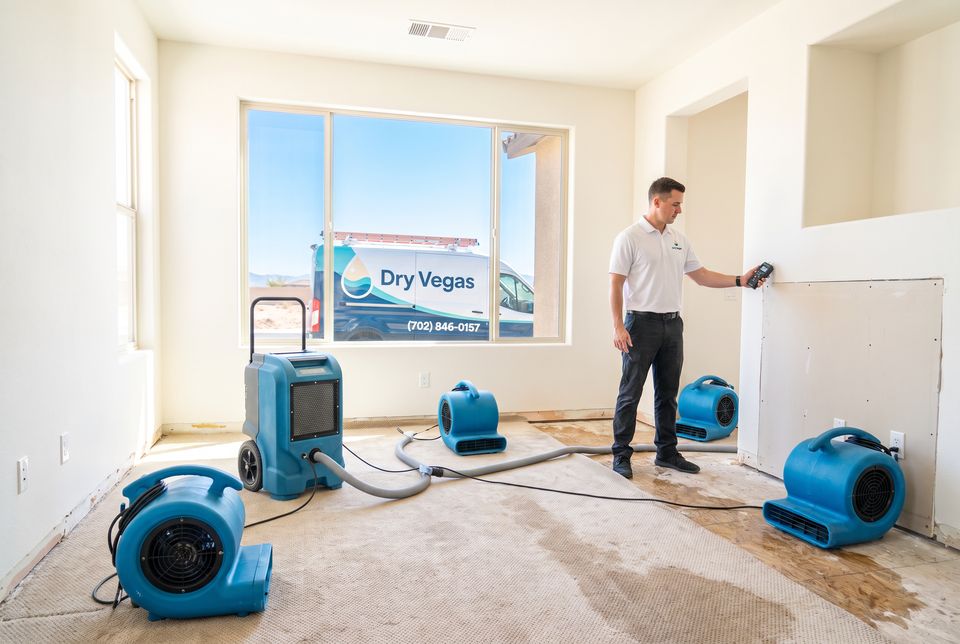
Moving air across the floor, a dehumidifier to take the water out of that air, and time. Pulling a few boards or the baseboard lets air reach the underside, where cupping starts. Heat alone dries the top first and can make cupping worse.
Can hardwood floors be repaired after water damage?
Yes, when the boards cupped and then flattened as they dried, or when only a few boards split or stained. A solid floor can be sanded and refinished once it reads dry. An engineered floor with a thin wear layer, or a floor that buckled, usually needs new boards.
How long does it take hardwood floors to dry after water damage?
Anywhere from days to weeks, and longer over a wet slab. It is done when the wet boards read close to the dry board in your house, top and bottom, and stay there. The NWFA allows only 2 percent between a plank floor and its subfloor, so use that as the gap to beat.
Who do I call first?
Shut off the water and call a plumber if a line is still leaking. Then dry the floor before mold has its 24 to 48 hours. Call or text Dry Vegas at (702) 846-0157 with which room, what kind of floor, and when the water started.
Choose Dry Vegas in Google's preferred sources
Reference Links
- USDA Forest Products Laboratory, Wood Handbook, chapter 13, drying and control of moisture content, 2021
- Western Regional Climate Center, mean afternoon relative humidity, 1996 to 2010
- Wagner Meters, wood floor cupping and other common problems
- National Wood Flooring Association, acclimation and conditioning guidelines
- National Wood Flooring Association, engineered wood flooring refinishable program
- EPA, a brief guide to mold, moisture and your home
- Insurance Information Institute, which disasters are covered by homeowners insurance
- Nevada Division of Insurance, consumer services
- Fixr, water damage restoration cost, January 2025
- Gorsegner Brothers, water damaged hardwood floors, 58 jobs
Next Guide
- Structural drying and dehumidification
- Burst and leaking pipes
- Slab leak damage
- Insurance claim help
- Slab Leak Signs Every Las Vegas Homeowner Should Know
- Does Homeowners Insurance Cover Water Damage in Nevada?
- How Long Does Water Damage Take to Dry in Las Vegas?
- Never Caulk a Window That Leaks in Rain Before You Test It
- 6 Leak Spots to Check Before Friday's Las Vegas Rain
- Monsoon Roof Leaks, and How to Tell Storm Water From a Slab Leak
- 5 Pipes That Freeze First in a Las Vegas Cold Snap
- Dry Vegas Is Under New Ownership and Back Serving the Valley
- What to Do After a Flash Flood Gets Into Your Las Vegas Home
- 5 Signs a Toilet Leak at the Base Reached Your Subfloor
- Las Vegas Storm History, the Floods That Hit the Valley
Service area
Serving the Las Vegas Valley
The whole Las Vegas Valley, from our office at 1517 Rainbow Meadows Dr, Las Vegas, NV 89128
Water where it should not be?
Wood floor took on water? Call or text. Say which room, solid or engineered if you know, and when the water started, and you will get the first steps right away.